Saturday, 8 March 2014

GOAL-II – ITS NOT LUCK


Read to Goal-II to get an idea on the following:

  •   How to sell effectively
  •   How to find root cause for a problem(Using Current reality tree method)
  •    How to reach a goal ( Using Prerequisite tree method)


 Goal-II is a build up to novel, Goal-I. Here, Alex Rogo faces completely different and tougher challenges. In Goal I, Alex Rogo transforms his plant from a bottomless pit to a highly profitable plant. He gets rewarded with a promotion and made responsible for diversified group. As an executive vice president, he has great vision for companies under his supervision. However, when markets hits downturn UNICO decides to sell companies under diversified group to improve cash reserves and cash flow. Alex faces daunting challenge of selling his 3 companies to three times the face value else his entire career is at stake.He succeeds finally using the following techniques.

How to sell effectively:- While selling a solution or a product , one shouldn’t start with all the positives of one’s solution. First, address the pain point of the market and quantify how much its costing .For example , legacy servers are causing 100000$ loss in revenue per annum  . Then brief your solution which address the solution. For example, virtualize your environment with investment of 40,000$. You save 60,000$ p.a. Then your solution is irrestible.

How to find the root cause for a problem using current reality tree:- Lets take problem of giving a separate state to Telengana. To find out the root cause first we have to list UDE undesirable effects like
  • *    People are resorting to violence
  • *    Both the regions want more money allocated for their development
  • *    Politicians in either sides are trying to maximize their gains.
  • *    Industry is losing money due to uncertainty.

   You may use post it notes to help with root cause.

 How to go about planning for a goal objectively using prerequisite tree: Let’s say Anil Ambani’s goal is to buy a luxury villa. Then write all the obstacles that prevent him from buying a luxury villa
  • Might not have money to buy it—Get a job which gives enough savings and follow a plan to 3 years to save 1 cr so that  you could afford to buy
  •  Villa might be very far from city – There are many villa projects within in 40KM of radius. Find out a good builder and with a car 40Km is not a big deal these days
  •     Selling it back might be very difficult- You might not want to sell it . Just use it as an investment for future purpose which gives 5cr for the 1cr you invested now .

Thus there is an action plan against each of the negatives . When the action plan is properly executed for each of these then automatically you would achieve Goal …! 

Finally , Goldratt’s objective through Goal-II is to explain intricate business concepts lucidly to an extent that they appear commonsense. When applied effectively they help in many real life situations like, Should i invest in equity during down turn? How to solve innumerable daunting issues at work? Goal-II meets its objectives well . Try applying theory to practice  J


Monday, 27 January 2014

Netbackup Oracle internal process


Backup :

Database tables are not directly copied to netbackup .

bporaexp/bporaexp64 utility


Database tables are first converted in xml files by bporexp/bporaexp64 in backups and then data is storage in netbackup storage unit 

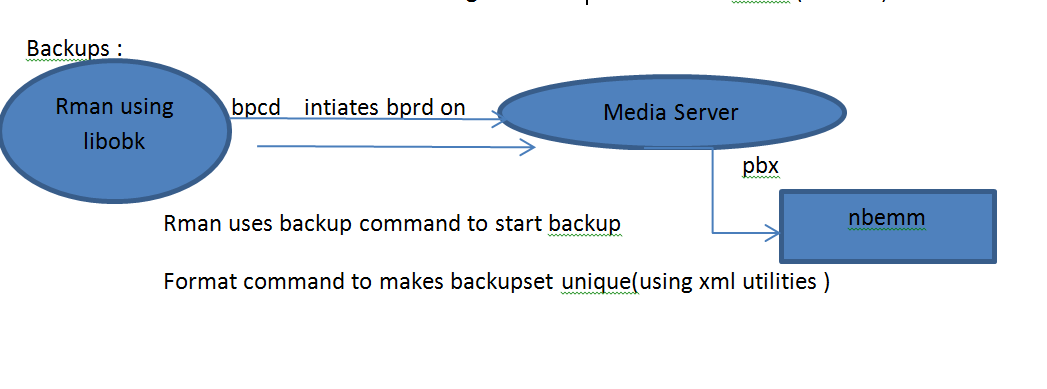
RMAN (oracle recovery manager ) is responsible for performing backups and restores . Rman can’t directly access media and devices it uses netbackup for oracle to uses the devices .

Rman does three things . identifies whether the opearation is backup or restore
What to backup or restore (Rman)
Submits a request for media server to accessing the media and devices for (backup/Restore ) using linking libobk or orasbt.dll
Process : Nbrb will be intaited on media servers
                 Nbrb will get the resources from emm
Controlls the flows of data into/out of databases
Process : Rman access the devices and bpbkar gets started and send the data . (Backup)
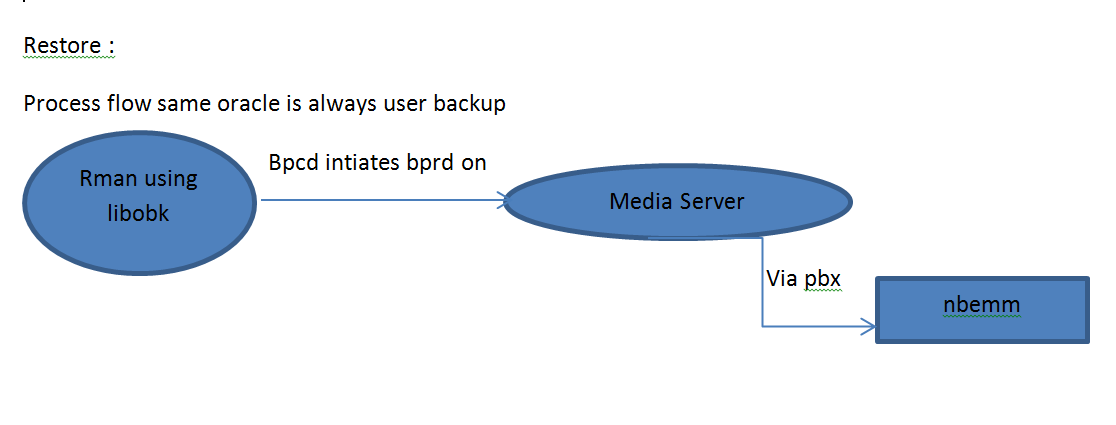
                  Rman access the devices and tar gets started and send the data . (Restore)


Once it gets the resources
                        Bpbkar gets intiates on clients .
                       Sends data to media server ( bpbkar puts data from client disk to networkà child bptm puts data from network to shared memory à parent bptm puts data from shared memory to disk )


Rman uses restore  command to start restores
                        Using netbackup library libobk talks to media server via bpcd to get resource
                        Once it gets the resources
                        Tar gets initated on the client and transfers data to client from media server
                          Parent bptm reads data from tapes/disk of mediaserver and puts in buffersà child bptm puts data from shared memory to network  -à tar reads data from network to client disk
Scripts:
/usr/openv/netbackup/ext/dbext/oracle/samples

Friday, 24 January 2014

Googly: Do Managers really matter at work ?


Google is a company set up by highly creative engineers for creative and crazy engineers. They innovate all the time and come up with crazy ideas .A company filled with “A” players who considered management a distraction from the designing and debugging they loved to do . Eventually ,  One day  an highly talented engineer , had this crazy idea of what do managers actually do ? . Do managers really matter ? .  Given the open culture of Google , this idea spread pretty fast and had gone to CEO of Google , Larry . Larry even took and reduced the number of managers per product line and wanted to see what happens  . The result ? . Things started working fine after managers are cut down…..!       only for a while  . Then things started getting worse .  CEO of Google started getting involved in expense reports , leave approval and guiding team through company’s vision .  The ploy has back fired royally and managers are back royally . But CEO of google wants to know what managers really do  . A comprehensive project called “ PROJECT OXYGEN” is launched to dig manager’s brain and  he he here the comes the tricky point document it  J J . Google’s management needs data to show and prove to its engineers why and how  managers are effective and required , for god’s sake otherwise they don’t accept after all its Google :) 
Google’s people analytics team  persuaded skeptics with data accumulated through “PROJECT OXYGEN “ . I'm sure if you are manager you would have googled up this term now :P  . In Google , engineers rate managers semi annually and annually and exit interviews would be conducted to figure out what could be improved . Project oxygen team started using this data to analyse . First , they analysed exit interviews to see if something could be deciphered  . The overall output of team with lower rating manager is almost similar to one with higher rating . Exit interviews did not help much . How to deciphere this riddle  ? . Finally , managers reviews revealed some interesting facts .  Entire team's performance is tightly in correlation with manager's effectiveness . A slight increase in management performance is increasing the teams results manifold .  

High performance managers differ from average ones in the following three categories .
1. Is a good coach.
2. Empowers the team and does not micromanage.
3. Expresses interest in and concern for team members’ success and personal well-being.
4. Is productive and results-oriented.
5. Is a good communicator - listens and shares information.
6. Helps with career development.
7. Has a clear vision and strategy for the team.
8. Has key technical skills that help him or her advise the team.

One more suprising fact found is , Employees love to have freedom and want to be independent in their work but they are willing to talk to their managers about their career growth . Further evidence is found when managers of higher score are analysed for in their work styles and impact on teams performance .High scoring mangers saw less turnover on their team than other did – and retention is relatively related strongly to a manager quality than seniority , tenure or promotions . The data also showed a tight connection between manager’s quality and workers happiness .  Employeed with scoring bosses consistengly reported greater satisfacation in mutli .


This shows that decisions taken by managers with common sense is not common after . We might need managers for much more than common things ..! 

Tuesday, 31 December 2013

Delivering Happiness : A path to profits, passion and purpose


This is an extra ordinary novel written by Tony . At the beginning of the novel itself , Tony clearly mentions that this is neither an auto biography of Z
appos or his . He wrote this novel as if he is speaking to a friend . I found the narration very captivating .

Tony comes from an oriental background . Like most of the Asian parents Tony's parents took pride in showing their kid's achievements .They made him  to prepare for SAT, right from the sixth grade . Tony had always been entrepreneurial from childhood , he started a personalized button making business in his childhood and it was a success . Tony finally made to Harvard.  Though, Tony used to pick and attend most his classes and procrastinating many . He manages to pass out with manageable grades . Tony along with his friend room mate Sanjay joined Oracle . He did not fancy his job at oracle and resigned oracle within six months . Along with his friend Sanjay Tony for the first time venture into making a web designing company by name Link exchange .  Link exchange becomes a huge success later on he lost interest in the company and sold it off to Microsoft for whopping 250 million $ . Microsoft offered a 40 million $ to Tony on stipulation that he continues in Microsoft for one year . But he could not continue in the company because he was passionate about it .

After a few months of dillydallying , Tony finally decides to start a investment fund company . He wanted to help buzzing entrepreneurs with his sources . He along with some of his friends invest in many small companies . But , very few companies gave returns Tony and his team expected . One of the firm he invested was Zappos . Fred who actually came up with the original idea of selling shoes online, which was and is the whole point of Zappos . But , world and industry was not ready for that concept . Zappos was loosing lots of  money. Tony poured almost 40 million $ from his investment fund into Zappos . But , it still was not sufficient to keep his company afloat . Tony and his friends looked for external investments . Neither major investors nor any banks were not interested in investing in Zappos . Zappos started doing well  but not making enough money to avoid insolvency . On the brink of insolvency , to save Zappos Tony even sold his own house to inject funds into Zappos .

Finally , looking at Zappos good track record WellsFargo decided to give credit line to Zappos . From that point of time , Zappos started doing really well . From 2003 , transformation of Zappos quickened . It transformed from an online shoe company to a customer centric company . Tony fixed an overwhelming goal of crossing the gross sales of 1billion $ by 2010 . He and his entire company worked diligently towards this goal . Tony built a very transparent culture in Zappos . All the managers heed to their employees and customers. Entire company worked passionately about one thing that is delivering happiness to its customers . Tony came up with a culture book that showed entire Zappos culture and what it meant to customers and its own employees and vendors . During 2008 recession , Zappos also got affected but trues to its core values the entire firing process was kept transparent . This had helped to keep the employees morale up even during the down time . Slowly , the entire ecosystem around eCommerce had changed and Zappos had become leader in online shoe sales . Zappos achieves its goal of crossing 1 billion $ gross sales two years ahead of its deadline . Finally   , Amazon showed interest in buying Zappos . After pondering for a lot of time , Tony and his team thought it was good for future of Zappos to merge with Amazon . Zappo's is a cinderalla story but its been carefully built by passionate people . It stands true to the fact that faith can do wonders . ..!

Manoj
12/31/2013                                                      

Tuesday, 10 September 2013

Power of Habit by Charles Duhigg

This is an excellent novel that talks about how habits form , how do they work and how can they be changed .

I am going to explain the crux of the novel in the following four segments

Ø  what is a Habit loop
Ø  What is a routine 
Ø  What is a cue 
Ø  What is the reward

Finally , how this can be changed

Before I started reading this novel I have a bad habit of not reading after I come from work


Ø  What is a habit loop

Cueà Routineà  reward


In my  case everyday I used to come waste time and sleep

Cue : come home
Routine : switch on TV , cook for time pass, check my office mails again
Reward : convince myself that I am tired and thus rejuvenated

What is a cue

Cue is something that triggers the routine that is bad habit

What is the reward

Reward is something that you get for following the routine .


To elaborate more on cue and reward relationship , for many people smoking is a bad habit , in my case its is not reading . People find it really difficult to break the bad habit loop even if they want to . The question is what makes it so difficult to break the pattern .Answer is habit loop that is formed in subconscious mind .However this  can be changed with following the below seemingly simple formula

Formula is  TOILE . though it doesn't sound right it actually works

T: time , what is the time when habit loop starts
O: Who are the other other people around you
I ; immediate proceeding action
L : location
E emotional state

In my case

Time:

Sunday. : at around 07:30 went out bought groceries and slept
Monday : come home my office at 07:30 , watched TV slept
Tuesday : came home at 07:00 attended a meeting , cooked and slept
Wednesday:Have some office work , worked late and slept

So it is clearly in my case habit loop is kicking in at around 07 to 08


Other people around you:

There is no one around . So others are not influencing me :-)


Immediate proceeding action:

Monday : travel led by bus from office to home
Tuesday : came by bike from office to bus

Location :

Home on all the days .

Emotional state:

Sunday : tired and want to take break as it is weekend
Monday : tired due to long day and want to take a break
Tuesday : tired due to riding bike in traffic and want to take a break


So cue is 07:30 , routine is waste time and reward is relaxed

I enjoy reading a lot so I got to replace TV watching , checking unnecessary mails , attending meetings , with reading and learning which is very helpful to my career

How ?

Pack new habit in the same loop to get the same reward
After coming home practised having power nap for half an hour during 06:00-07:00 , so I am not tired and thus not resorting to time waste means to get relaxed .
I am able to read most of the days .
As I enjoy it too,  I am getting my usual reward of relaxation ;)


Understand and unleash your power to change habits


Saturday, 30 March 2013

Crisis Management By Harvard Business Review Press

Crisis Management By Harvard Business Review Press .

                   Here is the essence of this book  . Personally, i took a week to read this and got a couple of chances to apply my learnings to real life situations , it has helped indeed . I would narrate this with the help of an imaginary character called Snigdha.


Snigdha is an amateur DBA in Acme Inc. As any employee in Acme, she rarely gets to work. God has blessed her with a very good project where she gets to work very rarely. Every day she spends more time on checking the quality of her dressing style than quality of her work. Her manager, who started her career also at the same position as Snigdha, attributes the reason for minimal work in the project to her management skills. Snigdha’s manager rarely puts an effort impart new ideas in team and assess new technologies .Rarely the tickets resolving procedures and teams technical skills be cross verified . On fine bad morning, customer has lost half of his database. So customer raised a production down ticket to Acme Inc. Snigdha picked the ticket and read a one-liner “replicate the production database to test” . She gave a look as if it’s her one of those spam mails in her inbox . Unaware of the process to be followed for high priority tickets, she replicated development to production which wiped out whatever the little data customer has got. It took 10 hours from there on recover it completely back.  Quality team who never got a chance to review the quality of anything but quality of office interiors, suddenly had to review the quality of work done by Snigdha. As they never followed any standard quality check procedure nor do they have any metrics. They decided to postmortem the ticket. They exhorted the ticket out of database and started analyzing. Suddenly, people started looking at her work (ticket) as if its manuscript of Jesus Christ. To save their day, quality team has simply put all the blame on Snigdha for not paying attention and sends the analysis report to customer. The poor non-technical customer was heavily bombarded with technical jargon and was convinced that it was his mistake for not giving the requirements clearly. Further, Acme Inc. gave some action items to customer on improving the communication on such incidents in future. Looking at the concern of Acme towards them customer has awarded the contract to Acme Inc again .

Here is how crisis should have been handled better . As per author of this book , lifecycle of any crisis can be put into 8 of the following categories .

1     Identification of possible areas of crisis.
2     Prioritsing crisis based on impact.
3       Crisis contingency plan
4    Crisis containment.
5       Communication to media
6     Documentation.
Applying these principles to above story gives the following results.


1     Identification of possible areas of crisis.

                            One of the important skills for any manager should be identifying the signs of crisis. Crisis can be anything ranging from unkemptly designed ergonomic chair to office building not complaint with security measures.  In this case, Snigdha was never working or practicing as she did not get a chance; she never had any experience handling these sort of high pressure tickets. Quality team should have a clear metrics to assess quality of someone’s work. It was her manager’s responsibility to pick up these signs and to make sure that Snigdha was competent enough. Her manager should have picked up the sign early and trained team appropriately.


2      Prioritizing the crisis based on cost of impact

Crisis impact can be estimated with simple formula.
Value of crisis = Probability of occurrence X Cost of impact
In this case, cost of impact = 10 employees had to work 10 hours more to resolve issue
                                                    = 2000$(10X20X10)     
         Customer losing business for 8 hours = 10000$
Probability of occurrence= 0.1
Value of crisis = 0.4X (2000+10000)$
                         = 5000$


3 ) Crisis contingency plan

In case of a crisis there should be a crystal clear plan on who should be contacted for resolution. How should be contacted, what are the emergency contact number of key resources. How to organize a team and how and who should send communication to customer on the crisis updates. These should have been in place by the appropriate team.

If Snigdha doesn’t know how to perform the activity, she should have at least known whom to contact when she is struck.


5 ) Crisis containment.

It is not completely possible to avoid all the crisis . But having a proper backup plan or an insurance never hurts.
In this case if entire business is going down, the team should have at least pondered over the strategy to contain at beginning stage like routing traffic to another database server. Having a backup copy at offsite location would have surely helped.


 6 ) Communication to media.
In this case , who would get intouch with customer incase of crisis . Good way to deal with this is, Manager should have come to office to handle the situation and percolate the seriousness . To show exigency and convey the gravity of something it is always better if someone at top goes to site and address media or customer .

Before addressing media or customer the manger or CEO should guess to 5 question that could be posed and visualize the answers and the way to deliver those answers.


 Documentation

The crisis should have been documented properly. This would help really incase of future situations. So when the database is fully recovered the whole history log how the ticket was issued should have been properly documented.

Customer should also have documentation on how the issue is resolved and ways to improve the procedure in future.


Must read for all the managers ….!  

Tuesday, 19 February 2013

Motivation


1001 ways to inspire your organization, your team and yourself 
–David E.Rye

This book is all about what its Title says

Humans can be classified into four categories

Type1: Inspirational: Leaders, bit of arrogant, Goal Oriented
Type2: Creative: Emotional team members
Type3: Followers and conflict avoiders
Type4: Uncommitted and jovial

First and foremost thing to inspire is , to know to which type you and people around you belong to. Let us take a look at how to motivate others. On a day to day basis, we interact with many people around. Everything that we speak, everything that we do and everything we express is not haphazard. Everything has a hidden motive. All the actions that we do are inter related, our actions somehow would have an impact either positively or negatively. There is no such thing called, unplanned or without consequence. Our day to day actions and our interactions with people around decide our path and finally destination of ours. So, it is every important to understand people around so that you can help them and can seek help to reach destination.  Every type of person can be motivated if we can understand them well and do sincere effort.
Type1’s love to take control of things and are powerful leaders. They would plan ahead for them and for their closed ones. They would go any farther to get proper recognition to them and their team and deliver results. Negative side is that they can be insensitive. They can be motivated by letting them know they could be in control of the project and can get name for it. They could put your project on your table before your deadline.

Type2’s are very creative and emotional. They are very loyal to what they believe. They could be very suspicious of nature at times. They could use little leadership from Type1’s. In case your organization wants a job to be done and to be delivered with great quality. Types2’s are your life savers.

Type3’s are followers. They would normally don’t get into conflicts. They would avoid conflicts to the maximum extent possible. But, in case you get into conflicts with these you could face a passive wall of resistance. They are loyalists your organization.

Type4’s are insouciant and jovial in nature. They are not very committed. They can be motivated by playing to their populist card. They love technology gadgets

Finally, how to keep one self-motivated. You can keep yourself motivated all times provided you know your goal (professional & Personal). Biggest motivation that can drive us towards our goal is the progress we are making. So a quantifiable goal is always achievable in specified time, investing specific effort at regular intervals. This would itself keep us motivated.

Regards ,
Manoj